Takeshi Mori · Nagaoka, Niigata Launch price $47 · ends in 5d 00:00:00 30-day refund · instant download
The Japanese Home Collection · three books

Heat one room, not the whole house, and keep about $2,000 this winter.

I'm Takeshi Mori. For 35 years I stocked the emergency shelters of Nagaoka, in snowy Niigata. Here is how a Japanese home stays warm for less, cool for less, and calm through 7 days without power, in three plain books.

$47 $131 All 3 books · launch price Winter · Summer · Grid down, plus 6 fridge-door cards and large print

One payment, no subscription. In your email within a minute. 30-day money-back guarantee, and you keep the books.

▶ Watch me explain the set (2 minutes)

Takeshi Mori at home
The Warm Room Manual When the Grid Fails The Cool House Manual
Takeshi Mori, 6335 years, Nagaoka disaster prevention office
Choose your copy
The Warm Room ManualThe Cool House ManualWhen the Grid Fails

The Japanese Home Collection

All 3 books: Winter, Summer and Grid down, with the 6 fridge-door cards and the large-print editions.

Get all 3 books · $47
The Warm Room ManualThe Cool House ManualWhen the Grid FailsThe Japanese Pantry Manual

Both: the collection + The Japanese Pantry Manual

All 3 books, plus the pantry book: a rolling Japanese pantry, 15 one-pot nabe and the 7-day no-fridge menu. Both in one checkout.

Get both books · one checkout
一The idea

An American house heats every room to warm one person. A Japanese house warms the person.

My daughter married an American and lives in Ohio. Two winters ago the power went out in a storm, and she called me in Japan and asked: Papa, what do Japanese families actually do when the heat goes out?

I had to laugh a little, because the answer is something every grandmother in Niigata knows. You do not heat the house. You heat one room, then the people in it, then the bed. You keep water and gas cans in the cupboard, and you know what to do in the first hour, so panic has nowhere to start.

In America almost nobody was taught this. So people pay to heat empty bedrooms all winter, pay to cool them all summer, and then buy a $2,000 generator because they are afraid of the dark week. That is three bills for one missing piece of knowledge.

I spent 35 years planning shelters and stocking them. I gave out water and blankets after the 2004 Chūetsu earthquake. These three books are what I would tell you if you sat at my kotatsu for one long evening.

  1. 一
    Heat the person, not the house.One warm room, a warm bed, the thermostat 10°F lower.
  2. 二
    Cool the person, then the room.Shade outside the glass, a breeze at the right height, the AC at 82°F with a fan.
  3. 三
    Plan for seven days, not three.Water, the toilet, one burner, light, and the first hour in order.
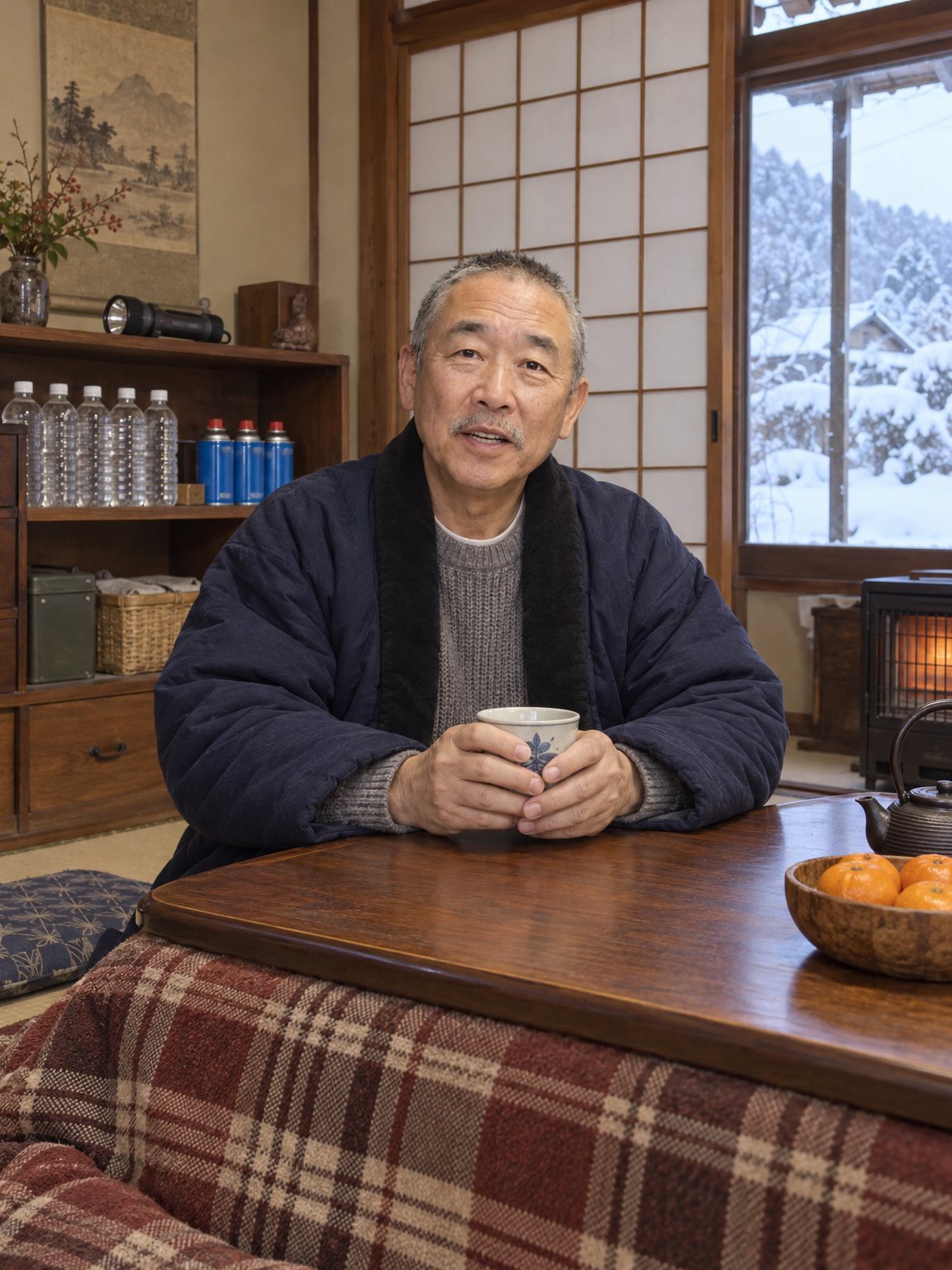
Takeshi explains the three books in about two minutes.

Every list from my videos, and the chapters you asked for that are not in any video.
二The set

Three separate books. One for each season of the house.

Two of them pay you back in lower bills. The third is for the week you hope never comes.

Winter
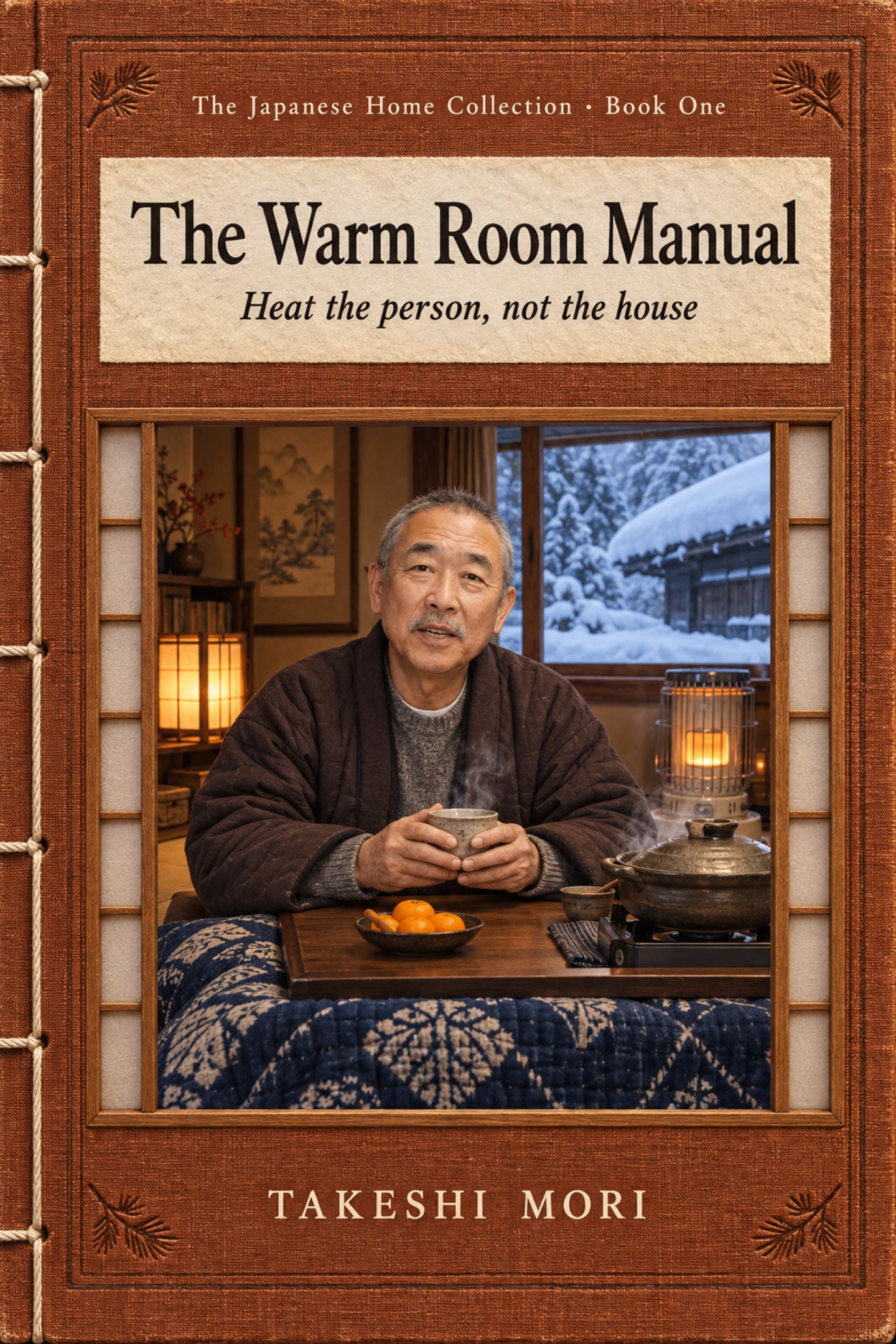
The Warm Room Manual cover
Book 1 · 30 chapters

The Warm Room Manual

Keep about $2,000 this winter: one warm room, a warm bed, the thermostat 10°F lower.

  • The 2-minute test that picks your warm room
  • The $6 door curtain that stops the cold hallway
  • A kotatsu-style table for about $40
  • Heat one room without bursting a pipe
  • The Winter Math, with your own fill-in ledger
Summer
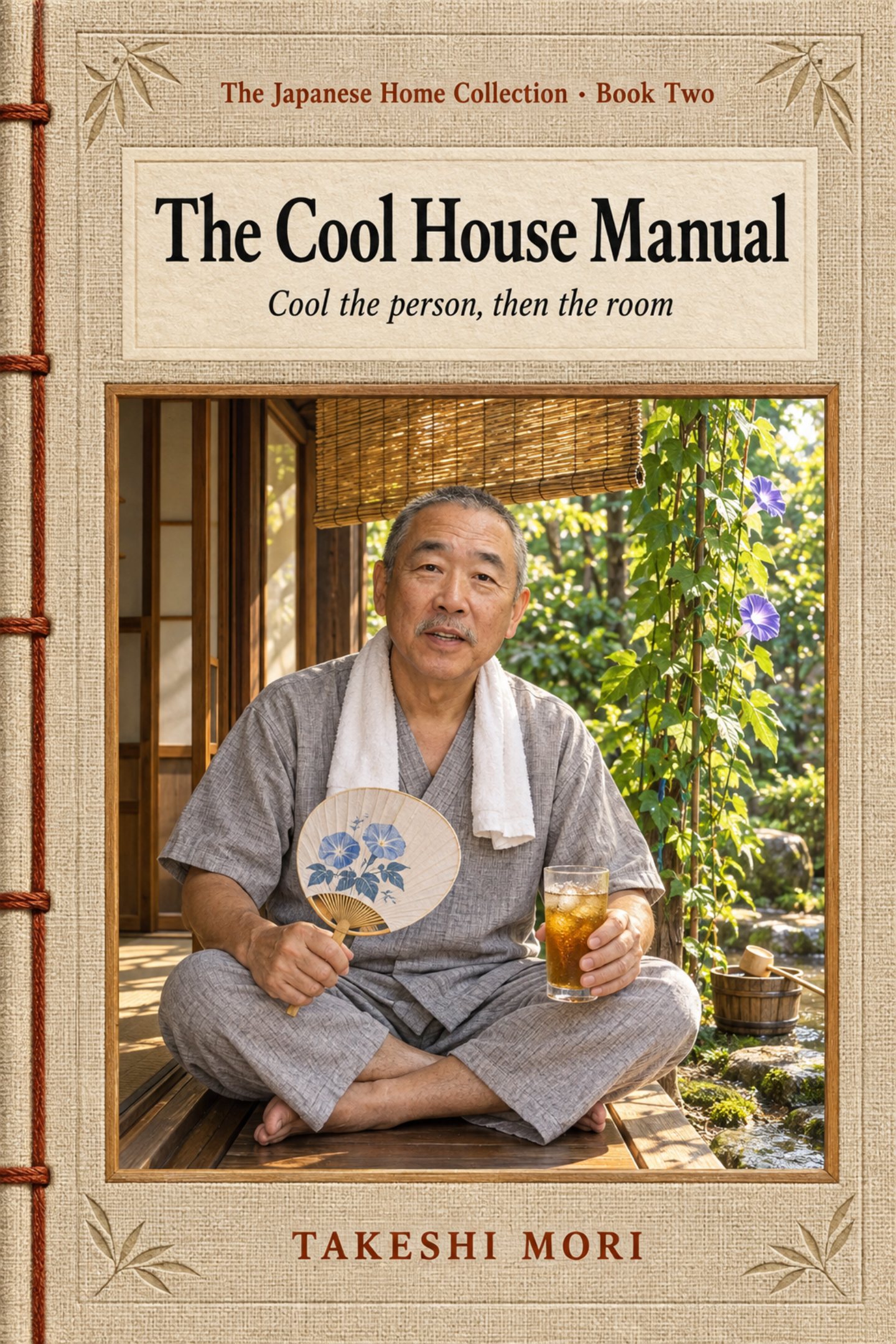
The Cool House Manual cover
Book 2 · 19 chapters

The Cool House Manual

How Japan lives through humid 95°F summers on far less air conditioning.

  • Sudare: the $20 outside shade that beats any curtain
  • Fan plus AC at 82°F, the setting that can halve the bill
  • Close at 9 a.m., open at 9 p.m.
  • The heat-stroke signs Japan teaches every senior
  • A heat wave with the power out
Grid down
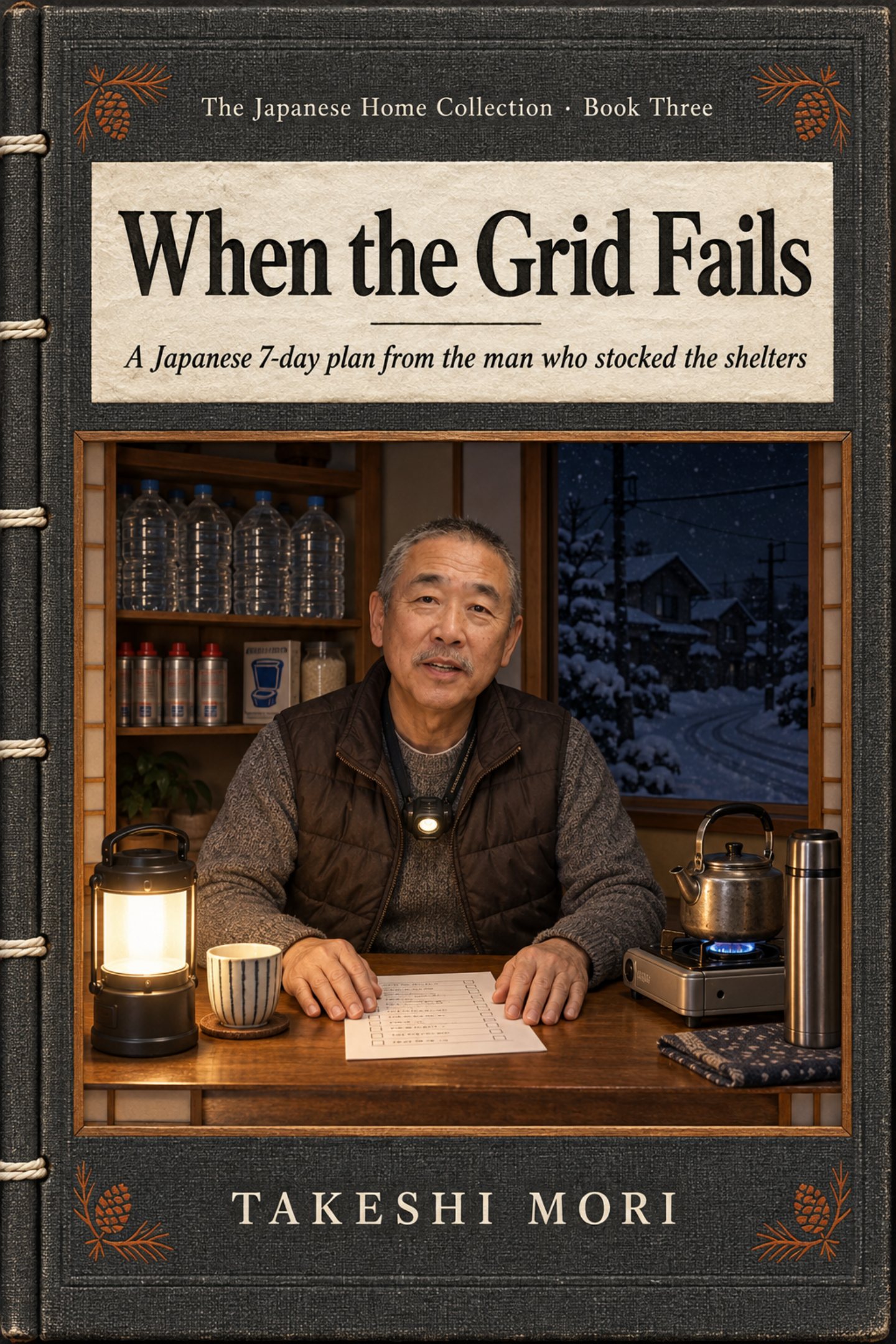
When the Grid Fails cover
Book 3 · 31 chapters

When the Grid Fails

My Japanese 7-day household plan, from the man who stocked the shelters.

  • Power out: the first hour, minute by minute
  • Hot water with the power out, five ways
  • The toilet-bag kit, and where the filled bags go
  • The cassette stove and the rules that keep it safe
  • The whole plan on one page, with Walmart prices
3Books
358Pages
80Chapters
6Fridge-door cards
30Day refund
Get all 3 books · $47 All three, every edition, one payment. 30-day money-back guarantee.
三The math

Where the $2,000 comes from, line by line.

Japanese households keep a kakeibo, a little account book. Here is one winter in mine, for a propane-heated American home of two, November to March. Book 1 has a blank one for your own numbers.

Winter kakeibo · kept, not spent

Nov → Mar
Heat: one warm room, thermostat 10°F lowerout of an average $1,210 propane winter
$400
Groceries: the Japanese winter pantryabout $90 a month, nabe and rice instead of takeout
$450
Power and hot water: the small winter savingsstandby power, water heater, the thermos
$100
The generator you don't need to buyportable generators run $500 to $2,000
$700
Freezer food you don't throw out in an outagethe cooler and fridge rules in Book 3
$300
Kept this winter
≈ $1,950

Sources: U.S. EIA Winter Fuels Outlook (average propane winter $1,210; heating oil $1,390; electric $1,133; natural gas $642), Angi (portable generator prices), NEADA June 2026 (average cooling spend $792, June to September). Your home will differ: gas homes save less on heat, oil and propane homes more. That is why the ledger in the book is blank for your own numbers.

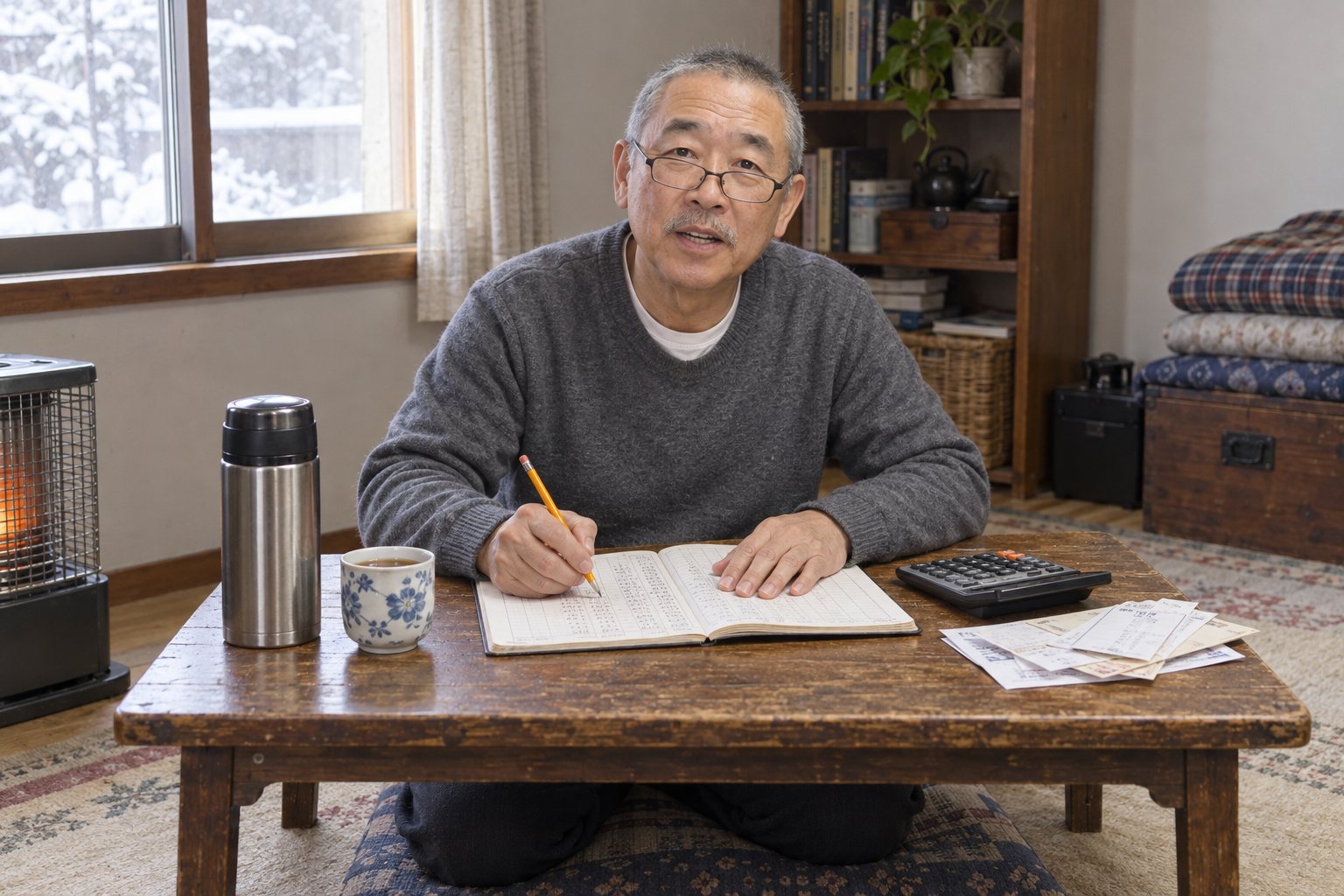
Takeshi writing numbers into his paper ledger
The heat line alone pays for the books in about three weeks.

And summer comes next: the average American home spends $792 on cooling from June to September. Book 2 shows how Japan keeps about half of that.

Three books, one payment of $47.

四Inside

Every part of all three books, in the order you'll use it.

Sixteen parts, eighty chapters. Prices are real US prices from Walmart, Dollar Tree, Amazon and Asian grocers, and the cheap way always comes before the expensive one.

How do I get hot water when the power is out?One of the most-asked questions under my videos · Book 3, Part 13
Where do the filled toilet bags go?Asked again and again under my videos · Book 3, Part 14
What about fire?Asked under my videos · Books 1 and 3, with the CO rules
Book 1 · Winter
The Warm Room Manual

1Heat the Person, Not the House

Why a Japanese house is livable at 58°F.
  • Why My Grandmother Never Heated the Whole House
  • Turn the Thermostat Down 10°F Without Shivering
  • The Winter Math: Where Your $2,000 Comes From

2Seal the Warm Room

Stop the cold for the price of a takeout dinner.
  • Find Every Draft With a Stick of Incense
  • Window Film, Bubble Wrap and Heavy Curtains: What Each One Really Saves
  • The Floor Is Stealing Your Heat

3The Kotatsu Way

Warm the body, and the room can stay cool.
  • Build a Kotatsu-Style Table for About $40
  • The Yutanpo: Japan's Hot-Water Bottle and How to Fill It Safely
  • Kairo Hand Warmers: Where to Stick Them and Where Never To

4The Warm Bed

Most heat is lost from below.
  • The Futon Layer Order That Keeps You Warm All Night
  • Getting Up at Night Without the Cold Shock
  • The Cold Bathroom Rule Japan Teaches Every Senior

5The Winter Kitchen

Food that warms the house and costs less.
  • Nabe That Warms the Room and Feeds Two for Under $5
  • The Thermos and the Towel: Cooking With Half the Fuel
  • Pickles for Winter: Napa Cabbage, Daikon and Cucumber in Salt

6Protect the Rest of the House

Pipes, heaters and bills, safe too.
  • Pipes in the Cold Rooms: Heat One Room Without Bursting a Pipe
  • Kerosene Heaters the Japanese Way: Fresh Air Every Hour and a CO Alarm
  • Help You Are Owed: LIHEAP, Budget Billing and Weatherization
Book 2 · Summer
The Cool House Manual

7Cool the Person, Then the Room

Japan's humid summers on less AC.
  • Fan Plus AC at 82°F: The Setting That Can Halve the Bill
  • Which Room to Keep Cool, and Which to Let Go

8Keep the Sun Out

Stop the heat before it reaches the glass.
  • Sudare and Yoshizu: The $20 Outside Shade That Beats Any Curtain
  • Uchimizu: Sprinkling Water to Cool the Ground Around Your House
  • Cross-Breeze the Japanese Way: Two Windows, One Fan, the Right Height

9Cool the Body

Cool skin, light cloth and cold food.
  • Bamboo Mats, Linen and Buckwheat Pillows: A Cooler Bed for Pennies
  • The No-Oven Summer Kitchen
  • Barley Tea, Salt and Water: Staying Hydrated After 60

10Heat Is Dangerous After 60

The summer safety plan Japan gives every older household.
  • Checking on Each Other: Japan's Neighborhood Heat Watch
  • Heat Wave With the Power Out: Keeping Cool When Nothing Plugs In
  • Your Summer Day, Hour by Hour, and the May Checklist
Book 3 · Grid down
When the Grid Fails

11What 35 Years of Disasters Taught Me

A 7-day plan from the man who stocked the shelters.
  • What I Saw After the 2004 Chūetsu Earthquake
  • Why Japan Plans for Seven Days, Not Three
  • Rolling Stock: The Emergency Pantry You Already Eat From

12The First Hour and the First Day

What to do in order, so panic has nowhere to start.
  • Power Out: The First Hour, Minute by Minute
  • Living Alone Through an Outage: The Plan for One
  • Medicines, Oxygen and Devices When the Power Is Out

13Water and Hot Water Without Power Not in the videos

Your most-asked question, answered in full.
  • Hot Water With the Power Out: Five Ways That Don't Need the Water Heater
  • Your Water Heater Is a 40-Gallon Emergency Tank
  • Making Doubtful Water Safe: Boil, Bleach, Filter

14The Toilet When the Water Stops Not in the videos

The chapter no one else writes.
  • Why Japan Stocks Toilet Bags Before Food
  • The Toilet-Bag Kit: What to Buy, What It Costs and the Trash-Bag Version
  • Where the Filled Bags Go: Storage, Smell and Disposal

15Cooking, Light and Power

A Japanese emergency kitchen and a phone that stays on.
  • Storing Cassette Gas: How Many Cans, Where, and for How Long
  • Light Without Fire: Lanterns, Headlamps and the Candle Question
  • Do You Need a Generator? An Honest Answer for Most Homes

16Fire, Cold and Getting to Day Seven

The rules we taught in every shelter.
  • Fire and Carbon Monoxide: The Rules We Taught at Every Shelter
  • Seven Days With No Heat at All
  • The 72-Hour Walk-Through: Practice One Weekend Before It's Real

At the back: The 30 Japanese Home Rules · Japanese words in plain English · The Seven-Day Stock Checklist · Your Winter and Summer Math Ledger · Where to Buy Everything in America.

Get all 3 books · $47 Instant download. Read on your phone, tablet or computer, or print it.
五Look inside

The card on your fridge, and the seven days it gets you through.

Six fridge-door cards come with the set. This is the first one. When the lights go out, you don't read a book. You read the fridge.

Power Out · The First HourCard 1 of 6
  1. Look out the window. Is it only your house? Then check the breaker panel before you call anyone.
  2. Keep the fridge and freezer shut. A full freezer holds its cold about 48 hours, a half-full one about 24, if the door stays closed.
  3. Unplug what came on with a surge. The TV, the computer, the microwave. Leave one lamp switched on so you know when power is back.
🔒 The full card, and the other five, come with the set
  1. Hour1

    The first hour, in order

    The card above. No panic, because every step is already decided.

  2. Day1

    Water counted, the warm room closed

    How much you have, where it is, and the 40 gallons in your water heater.

  3. Day2

    The toilet-bag kit goes in

    Lining the bowl step by step, and the trash-bag version.

  4. Day3

    One burner, three warm meals

    The cassette stove, the thermos, and food from the rolling pantry.

  5. Day4-6

    Light, phone power, checking on neighbors

    Lanterns instead of candles. A phone that stays on for a week.

  6. Day7

    Still warm, still fed, still home

    Or, if it's time to leave, leaving the Japanese way, in order.

六Comments

What viewers write under my YouTube videos

Real comments, quoted word for word.

I never considered putting a bag in the toilet. That is a great idea. I wanted to thank you for the calmness in your voice. Thank you for this video.

@ginabaker8167grid-down video

When the power's gone out in winter, we cover open doorways with blankets to keep our One Room cozy.

@Pbav8torone warm room

Extremely helpful! I even made notes. Wrote a list. Thank you!

@papphenriettwinter tricks

I grew up in London so I have about 27 hot water bottles 😂 They are so cozy and save so much money in heating bills 👍👍

@LeeKnowismySpiritAnimalhot water bottles

Toilet bags one of the things I need and I thank you for sharing it. I didn’t even know they made anything like that thank you.❤❤❤

@renneajohnson421toilet bags

Charming video ! I've learnt much from this very educative talk ! Thank you so much for sharing your knowledge !

@CarolAugier-z3gstaying warm

Love the Japanese words! Thank you for sharing your culture of honor

@DBaci-g9twinter tricks

Thank you for your great vision of knowing what can be done , not later 💞🌏😇

@suecunningham3131grid-down video
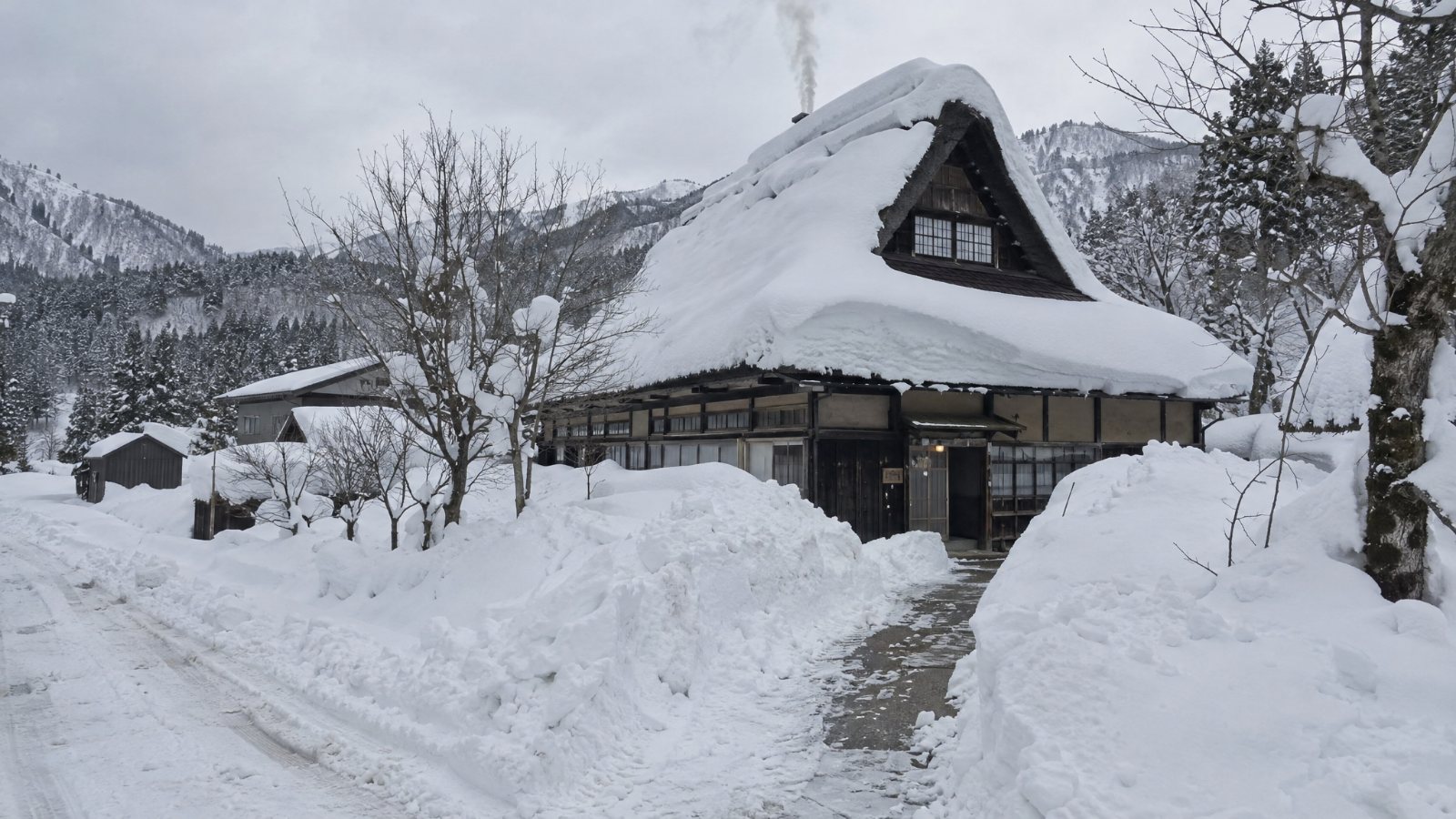
An old farmhouse in deep snow in the mountains of Niigata

The mountains of Niigata in winter, where I grew up. Snow to the windows, and no central heating.

BornA farmhouse in the mountains of Niigata, one of the snowiest places in Japan
35 yearsThe disaster prevention office of the city of Nagaoka: evacuation shelters, emergency stockpiles
2004Handed out water and blankets after the Chūetsu earthquake
TodayRetired three years, 63, and my own house is still stocked
七 · About Takeshi Mori

A note from the author

My grandmother ran a house through Niigata winters with a kotatsu, a futon and a pot on the fire.

I grew up in that farmhouse. We had no central heating. We had a kerosene stove, thick futons, pickled vegetables in the cellar and a pot of something always on the fire. Nobody in the house was ever really cold, and nobody spent money they didn't have to. My grandmother would call it mottainai: what a waste, to heat a room nobody sits in.

Then I spent 35 years at the city's disaster prevention office in Nagaoka. I planned the evacuation shelters, I checked the stockpiles, and after the 2004 Chūetsu earthquake I stood in the cold and handed out water and blankets. I saw which families were ready and which were not. The ready ones were not rich. They simply knew the order of things.

“The ready families were not rich. They knew what to do first, and they had already decided.”

I'm not an engineer and I'm not a doctor. I'm a retired city planner who stocked shelters for a living, and who still keeps his own house the way he taught everyone else to. I always tell you the cheap way before the expensive one. These books are written the same way.

Takeshi MoriNagaoka, Niigata
八Your copy

Everything in the set, for one payment.

All three books, every edition, and the cards for the fridge.

The Japanese Home Collection

358 pages · 80 chapters · 16 parts · instant download

  • Book 1 · The Warm Room Manual
    $47
  • Book 2 · The Cool House Manual
    $37
  • Book 3 · When the Grid Fails
    $47
  • The Japanese Home Shopping Sheet: every item, real US prices, the cheap swap
    $14
  • 6 fridge-door cards: Power Out, Furnace Died, Heat Wave, Water Cut, Toilet Without Water, Monthly Check
    $18
  • Large-print and Kindle editions of all three books
    $20
  • The Year-Round Readiness Calendar: one small step a month, on a fixed income
    $12
  • Editable Word versions and lifetime updates
    $21
  • Total value
    $216
🔒 Launch price · ends in 5d 00:00:00
$131$47
for all three books · one time · no subscription · yours forever
Get all 3 books · $47
Secure checkout
In your email in a minute
Phone, tablet or computer
30-day money back
30DAYS

Read them, use them, and then decide.

If they don't leave you warmer, cooler and more ready than the day you bought them, email me within 30 days for every cent back, and keep all three books. No forms, no questions.

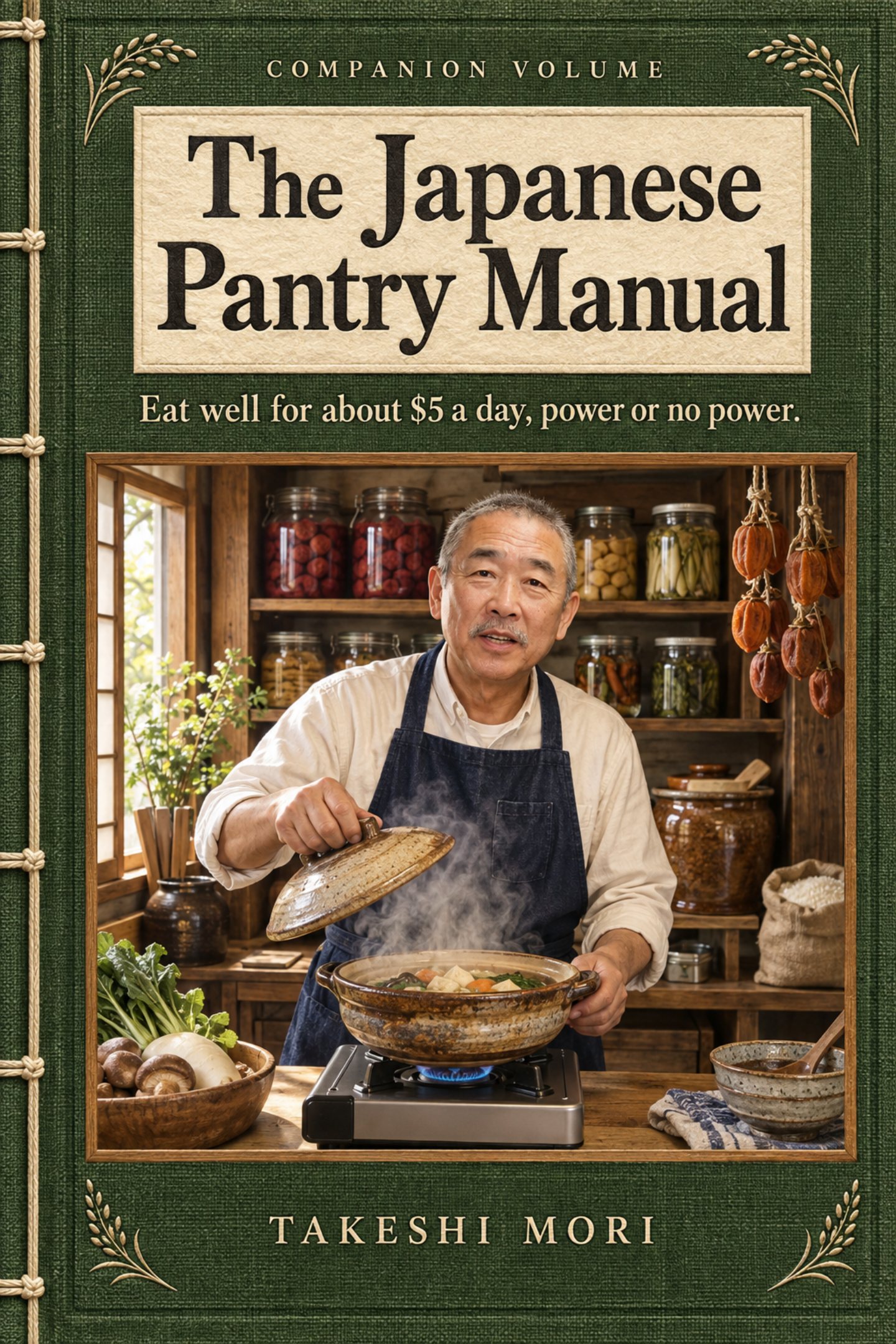
The Japanese Pantry Manual cover

On the checkout screen: The Japanese Pantry Manual

Keep the house fed well and cheaply all year, and through an outage, with a rolling Japanese pantry and one pot. 134 pages, 15 one-pot nabe, the 7-day no-fridge menu. You'll be offered it once for $25. Say no and nothing changes.

1You payThrough Gumroad's secure checkout, used by big online stores. I never see your card number.
2The books arriveOn the next screen and in your email, about a minute later. Nothing is shipped. There is no account to make.
3Start tonightOpen Book 1 at the $40 Warm Room. One afternoon to set up, and you feel it the same night.
From the comments:
Extremely helpful! I even made notes. Wrote a list. Thank you! @papphenriett
九Plainly

Who these books are for, and who they are not for.

For you if…

  • Your heating bill scares you more each November.
  • You live alone, or you look after someone who does.
  • You rent, or you have no ladder and no tools. Almost nothing here needs either.
  • You want one written plan you can print and tick off.
  • You'd rather spend $40 than $2,000 to feel safe in an outage.

Not for you if…

  • You want a bunker, guns, or doomsday talk. There is none.
  • You want a plug-in gadget for every room. I'll show you the cheap way first.
  • You want a printed book in the mail. This is a digital download you can print at home.
  • You already heat one room, keep 7 days of water and own toilet bags. You know most of it.
  • You're looking for charcoal kotatsu or old Edo tricks. This is how Japanese homes live today.
十 · Questions

What people ask me before they buy

Is this one book or three?

Three separate books, each with its own cover and title: The Warm Room Manual (winter), The Cool House Manual (summer) and When the Grid Fails (the 7-day plan). You get all three, plus the cards, the calendar, the shopping sheet and the large-print editions, for one payment.

I'm not much good with computers. Will I manage?

Yes. After you pay, the books open on the next screen and arrive in your email. You tap the file and read it, like a photo someone sent you. If anything goes wrong, reply to that email. It comes to me, and I'll send the books again.

Is the type big enough?

The books are set in large, clear type, and the set includes large-print editions of all three. You can also make the text bigger on any tablet, or print the pages you use most.

Will it really save me money? I already keep the heat low.

Then you're halfway there, and the Winter Math chapter will show you the rest: the bed, the floor, the bathroom, the kitchen, the hot water. The $2,000 is for a propane-heated home of two. Yours may be more or less, and the ledger in Book 1 lets you work out your own number. If the books don't pay you back, the guarantee does.

Is a kerosene heater or a kotatsu safe?

That is one of the most important chapters. Kerosene heaters only the Japanese way: fresh air every hour and a carbon monoxide alarm. Kotatsu only electric, never charcoal. Space heaters with the 3-foot rule. And a whole part on fire and CO, the rules we taught at every shelter.

I live alone. Is there a plan for one person?

Yes, a whole chapter: Living Alone Through an Outage. Who checks on you, what you write down, medicines and devices, and when it is time to leave.

Is this in the free videos?

Some tips, yes. But not in order, not with the prices, and not complete. The water and hot water part, the toilet-bag part with where the bags go, the pipes, the Winter Math and the 7-day plan are not in any video. They're the questions you asked me.

Can I buy it for my mother or father?

Many people do. Buy it with your own email, then forward the email or print the books and the six fridge cards for them.

Money is tight this year. Is it worth it?

I understand, and that is exactly who I wrote it for. The heat line alone covers the price in about three weeks. And if it doesn't help you, email me within 30 days and every cent comes back. You keep the books.

Pick the warm room before the cold comes, not after.

The first hard freeze is when the bill jumps and the lines get long. Three books, the fridge cards and a calm plan, ready on your phone tonight.

Get all 3 books · $47
$131 · One payment · instant download · 30-day money-back guarantee
The Japanese Home Collection3 books · 358 pages · 30-day refund
Get all 3 · $47
Get both books

The Japanese Home Collection + The Japanese Pantry Manual

The Japanese Pantry Manual: Keep the household fed well and cheaply all year, and through an outage, with a rolling Japanese pantry and one pot.

Get both for $72 $168
One order, both books — instant download
The Japanese Home Collection
Launch price · save $84
The Japanese Home Collection
480 pages · instant download
$47$131
Get all 3 books — $47See what's inside
30-day money-back guarantee